





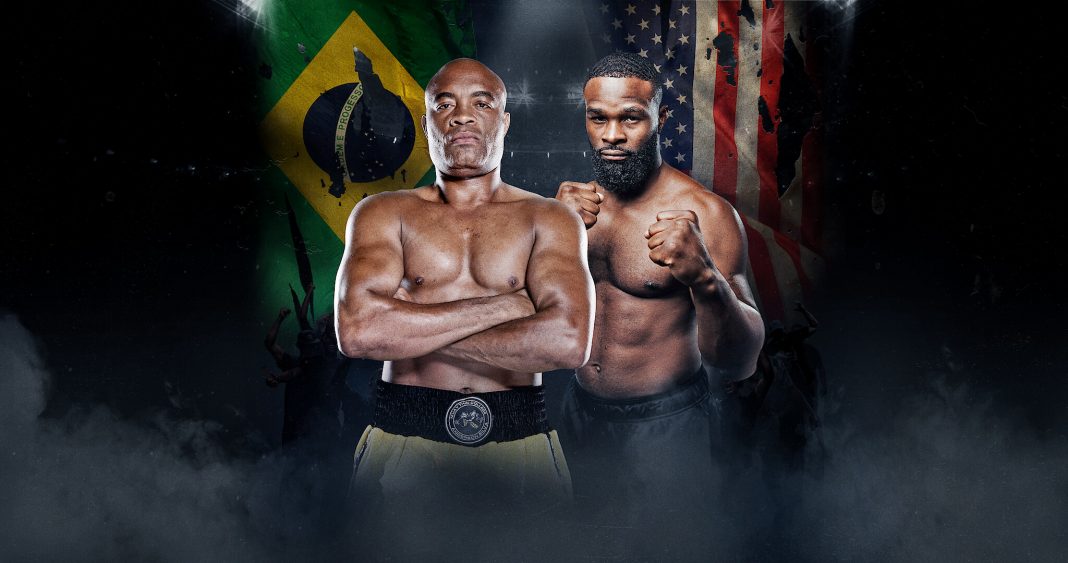

Anderson Silva vs Tyron Woodley Preview
Tyron Woodley and Anderson Silva return to boxing action when they fight on the undercard of the Jake Paul vs Anthony Joshua fight on December 19th. It is a matchup between two former UFC champions whose legacies intersect at an intriguing point in their post-MMA careers.
Boxing matches involving former UFC stars are always unpredictable. Can Woodley land something meaningful early and drag Silva into a physical fight, or will the Brazilian’s timing and experience allow him to control another high-profile crossover bout?
Anderson Silva vs Tyron Woodley Predictions
Fight prediction: Silva by decision or late stoppage
One of our best boxing predictions is for Anderson Silva to defeat Tyron Woodley in Miami. Silva is a fighter defined not by raw speed or sheer power, but by timing. He has pure, surgical, almost predatory instinct. Even at this stage of his career, his sense of distance remains elite. His ability to make opponents miss by millimetres is still world-class. The Spider’s boxing performances against Julio César Chávez Jr. and Tito Ortiz showed that his fundamentals translate smoothly into the ring. His footwork remains light, his angles sharp, and his shot selection intelligent.
Silva will begin the fight with patience, using feints and rhythmic pauses to draw Woodley into reaching. That is where Silva thrives. He baits reactions, then punishes them. Expect him to open with long, flicking jabs that are less about scoring and more about disrupting Woodley’s stance. Silva’s understanding of cadence will be the backbone of this fight. Woodley can be tight and hesitant with his output, and Silva’s style is designed to exploit exactly that.
Silva’s success comes from controlling the geography of the ring. He circles, pivots, and forces opponents to turn into shots they didn’t see coming. His ability to punch off the pivot remains one of his best weapons. Even now, he doesn’t need power to hurt opponents. Instead, he uses perfect timing, and he still has it in abundance. Over the course of the fight, expect Silva to manage range with ease, keeping Woodley at the end of his jab and countering with straight rights and check hooks whenever the American overcommits.
Woodley arrives as a former UFC champion whose power remains dangerous, even in boxing. His right hand is still a fight-changer, and his athleticism hasn’t vanished. But boxing is built on output and consistency. Those are two things Woodley has struggled with in his crossover bouts. He is disciplined and explosive in bursts, yet too often he watches rather than works. Against a rhythm disruptor like Silva, those idle stretches can cost entire rounds. To win, Woodley must close the distance, cut off the ring, and turn the fight into close-quarters exchanges. His best path is to land something heavy early to force Silva out of his comfort zone.
If Woodley can make the fight messy and physical, he can pressure Silva onto the ropes and take away the Brazilian’s ability to dictate rhythm. That makes him significantly more dangerous. However, Silva has always excelled against opponents who rely on singular power shots rather than layered combinations. He reads isolated punches easily. It is combinations and volume that trouble him. Woodley does not typically offer those looks.
Silva’s biggest advantage is his ring IQ. He builds slowly, stacking information through feints, slips, and subtle shifts. Once he has those reads, he begins landing cleaner and cleaner. Woodley is durable and proud, but sustained precision tends to show. Expect Woodley to have moments early, especially if Silva takes the opening rounds to analyse his movement. But once he begins timing the entries, the fight should tilt decisively and finish with a late stoppage or Silva running away on the scorecards.
Anderson Silva vs Tyron Woodley Betting Tips
- Method of Victory – Silva via decision: Six-round fights are tricky for anyone betting on boxing. The shorter format limits the time available for knockdowns, momentum swings or late rallies, which often pushes competitive fights toward the scorecards. Silva is the cleaner puncher, the more fluid mover, and the more consistent operator over extended stretches. His jab, feints, and distance control should allow him to bank early rounds while forcing Woodley into long periods of inactivity. Unless Woodley lands something huge, Silva’s accuracy and timing should be enough to secure a points win. The decision line offers the safest combination of value and likelihood in what is likely to be a measured, tactical bout.
- Grouped Round Betting – Silva rounds 4-6: If you are looking for longer odds, then this is the best way to bet on Silva. He is worth 2/5 with our online sportsbook, and this will extend those odds. Silva is not a fast starter in boxing. He takes his time, builds reads and slowly strips away an opponent’s confidence through rhythm manipulation rather than raw pressure. Woodley has proven to have less than elite head movement in his boxing career. The Spider definitely has the power to finish Woodley, and if we do see a finish, it is likely to come in the later rounds when Silva has finished doing his homework and goes in for the killshot.
- Accumulator Bet – Joshua, Silva, and Baumgardner to win by KO/TKO: If you’re looking to boost your return with a multi-leg play, combining these three fighters to win offers one of the strongest accumulators on the card. Anthony Joshua remains one of the most devastating heavyweight finishers of his era. With his recent run of knockouts and renewed aggression, a stoppage is always the most likely outcome whenever he steps into the ring. Alycia Baumgardner rounds out the treble as a heavy favourite to defeat Leila Beaudoin in Miami.
Silva vs Woodley Head-To-Head and Key Stats
Anderson Silva Analysis and Key Stats
The Spider’s recent form in boxing tells a story of a fighter whose skills have aged with remarkable grace. His 3-2 professional record doesn’t fully capture how sharp he has looked since making the switch. The standout performance remains his split-decision win over Julio César Chávez Jr, who is a former world champion with more than fifty professional bouts. Silva didn’t just survive that fight; he controlled it. He dictated distance, manipulated tempo, and consistently forced Chávez Jr. to miss by narrow margins. It was the kind of win that confirmed Silva’s striking fundamentals were not just effective in the MMA; they were transferable at a high level.
Even his quick knockout of Tito Ortiz, while less meaningful competitively, showcased the timing that defines him. Silva doesn’t rely on speed anymore. He doesn’t need to. His game is built on cadence, feints, pivots, and precision. Exhibitions with Bruno Machado and Chael Sonnen only reinforced that his rhythm remains smooth and his eyes are still world-class. Fighters who rely on intuition rather than athleticism tend to age better, and Silva is a perfect example.
As one of the best UFC fighters of all time, Silva is a fighter who understands exactly what he can and cannot do. He keeps the fight at his preferred range, builds reads slowly, and chips away through accuracy instead of volume. Against opponents with limited boxing experience, that alone is often enough to separate him. Silva’s form suggests not only competence, but comfort. That is rare for a crossover fighter in his late forties.
Tyron Woodley Analysis and Key Stats
Tyron Woodley’s transition into boxing has been far more turbulent. His 0-2 record, with both losses coming against Jake Paul, frames the challenges he has faced adapting to the sport. In their first meeting, Woodley showed flashes of the power that once made him a UFC champion, but long stretches of inactivity cost him rounds. Boxing punishes hesitation, and Woodley’s low-output tendencies were present even during the latter part of his MMA career.
The rematch ended more decisively. Woodley was knocked out in the sixth round, a result that highlighted the predictability of his approach. He relies heavily on a single right hand, struggles to build combinations, and waits for openings rather than creating them. In MMA, his explosiveness allowed him to get away with that. In boxing, it leaves him chasing moments instead of winning rounds.
His final years in the UFC also reflect a downward trend. Losses to Kamaru Usman, Gilbert Burns, Colby Covington, and Vicente Luque all followed a similar pattern: hesitancy. He also displayed an increasing unwillingness to pull the trigger. Those habits didn’t disappear when he put on the bigger gloves.
Woodley remains physically strong and undeniably dangerous in bursts. However, his difficulty maintaining rhythm, his reliance on isolated power shots, and his lack of sustained offence make him far easier to read in a boxing ring. Against a rhythm manipulator like Anderson Silva, those issues become structural disadvantages rather than tactical ones.