
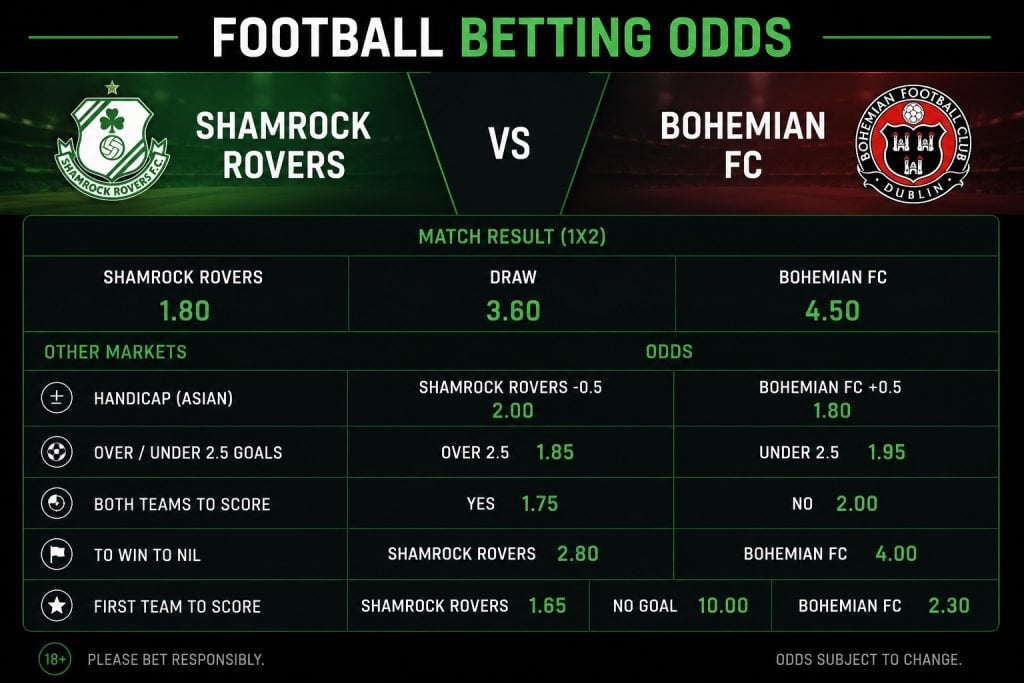
Betting odds show the likelihood of an outcome and determine how much you can win from a successful bet. The shorter the odds, the more likely the outcome is considered. The longer the odds, the bigger the potential payout. Understanding how betting odds work is essential before using any online betting site.
Odds are typically displayed in three main formats: fractional, decimal, and American. While they look different, each format represents the same core information: probability and potential return. This guide explains how betting odds are calculated, how to convert between formats, and how bookmakers build their margin into the prices. Once you understand how odds reflect probability and payouts, you can make more informed betting decisions and identify value more effectively.
What are Sports Betting Odds?
Sports betting odds are determined by bookies when estimating how likely an event is to take place. Say you wanted to bet on the Six Nations. Ireland enters the competition as the favourites, which is why they are priced at 1/1. In the fractional format, 1/1 simply means you will receive as much in profit as you are willing to stake. Irish sports betting fans prefer the fractional format as it represents the ratio players can expect to win. Say you wanted to bet on England to win the Six Nations at 8/1. This format means that for every €1 you bet, you will receive €8 in return, plus your initial stake.
To put it in its simplest terms, betting odds represent the likelihood of an event coming true. A lot goes into these calculations behind the scenes, but all you need to worry about is how an online bookmaker values an event. Each platform will offer odds of different sizes for the same events, so it pays to shop around. However, if you do not want the hassle of managing multiple sportsbooks, look for one with consistently good prices across all the sports you want to bet on.
How are Betting Odds Calculated Online?
Bookmakers calculate betting odds using a wide range of factors. These include home advantage, team form, injuries, and whether key players are expected to feature. All these elements help determine how a market is priced, although bettors should still do their own research before placing wagers.
A simple example can be found at Novibet. In Premier League betting, Arsenal may be priced around 5/1 because they are viewed as genuine title contenders. Fulham, meanwhile, could sit at 250/1 due to their far lower chances of winning the league.
The exact process behind calculating odds is highly complex, but the numbers still tell you a lot. Odds of 10/1 usually indicate an unlikely outcome, though outsiders still win regularly in horse racing. In soccer betting, shorter odds are often attached to consistent events, such as Erling Haaland scoring anytime. Because of that, many bettors look beyond the obvious favourites when searching for value.
How do you Read Betting Odds Online?
Whether you’re using Novibet or any other online sports betting site, reading betting odds is simple. Most platforms allow you to switch between fractional, decimal, and American (moneyline) formats, so you can choose the one you understand best. Each system represents the same concept: how much you could win based on your stake and the likelihood of an outcome.
Every bookie will have a range of sports for players to bet on, and each sport will feature a variety of markets. For soccer, you can bet on the match winner, the number of corners, the total goals scored, and much more. The same applies to anyone betting on Gaelic football, as you can bet on the points, goals, or even whether a player picks up a black card. The difference between the odd systems is down to preference. Below, we explain how to read each type of betting odds, whether you want to master fractional, decimal, or the American system.
| Format |
Example |
Meaning |
| Fractional | 10/1 | €10 profit per €1 staked |
| Decimal | 6.00 | €6 total return per €1 |
| American | +500 | €5 profit per €1 |
Fractional Odds
Fractional odds are popular in Ireland and the UK. They are written as A/B, where A is your potential profit, and B is your stake. This format is arguably the most difficult to understand, especially for beginners. However, once you know what to look for, it can be much quicker to scan through all the possible markets. A good way of remembering how to read fractional odds is: if the number on the left is bigger than the right, it’s an underdog. If it’s smaller, it’s a favourite. Betting €5 at 5/1 returns €30 in total.
- 1/1 pays €1 for every €1 staked (evens)
- 5/1 pays €5 for every €1 staked (odds-against)
- 20/22 pays €20 for every €22 staked (odds-on)
Decimal Odds
Decimal odds are common in Europe and South America. They show your total payout, including your stake. Many punters across Ireland are using this system as it’s straightforward to spot an underdog and a favourite. In decimal odds, anything below 2.00 usually represents the favourite. Over 2.00 means an underdog. Two is important as 2 signifies when the bet will return more profit than your stake. Staking €100 on a market worth 1.99 will return €199 in total; that includes your €100 wager and €99 in profit.
- Oleksandr Usyk 1.62 – €1 bet returns €1.62
- Tyson Fury 2.20 – €1 bet returns €2.20
- Draw 16.00 – €1 bet returns €16
American Moneyline Odds
American odds are mostly used in the US. Positive odds (+) show potential profit on a €100 bet, while negative odds (−) show how much you must stake to win €100. Positive odds indicate an underdog and negative odds indicate a favourite. American odds are also ideal for parlays or accumulators, where multiple bets are combined. This format is ideal for punters who do not mind adjusting their stake. For example, betting on the Patriots to win with odds worth -150 requires the player to stake €150 to win €100. If the market was worth +150, a €100 bet would return €150 in profit alone.
- Philadelphia Eagles −238 – €10 bet returns €14.20
- Pittsburgh Steelers +180 – €10 bet returns €28
- No Overtime −2500 – €10 bet returns €10.40
- Super Bowl Futures +2300 – €10 bet returns €240
Implied Probability in Sports Betting
Implied probability is the percentage chance of an outcome happening based on the betting odds offered by a bookmaker. In simple terms, it shows how likely the sportsbook believes a result is to occur. Understanding implied probability can help bettors identify whether odds offer genuine value. Shorter odds represent a higher implied probability, while longer odds represent a lower one. For example, odds of 1/1 (2.00 in decimal) imply a 50% chance of winning. Odds of 4/1 imply a 20% chance. Here are a few simple examples:
- 1/2 = 66.7% implied probability
- 1/1 = 50% implied probability
- 2/1 = 33.3% implied probability
- 10/1 = 9.1% implied probability
Bookmakers also build a margin into their prices, which means the combined implied probability of all outcomes usually exceeds 100%. That margin is how sportsbooks guarantee long-term profit. While we could go on with the technical side of betting on sports, all you need to know is that each market has been carefully calculated and selected. It’s your job to either browse the relevant options or experiment with a bet builder to ensure the best returns.
Converting Betting Odds
If you are looking to convert between different betting odds systems, the best place to start is with an online calculator. You can enter the odds for one format and see how they are represented across all three formats. You can then easily adjust the size of your stake to see the returns.
If you want to avoid a calculator, the online sportsbook at Novibet has what you need. Our platform allows you to change between all three systems at the click of a button. You can do so by locating the gear icon in the top right corner of the betting page. Here you can easily flick between fractions, decimals, and the American format to see how each system compares.
How do Odds Affect Payouts?
The odds directly affect the size of your payout. For most sporting events, the odds change on the fly. That means you will see different betting odds the day before the event, five minutes before the start, and throughout the fixture. Live betting is where the odds can change the most.
If you are looking to bet on a horse race or rugby game while it is taking place, the odds can shift dramatically based on the event. Individual players can see their odds slashed if they get close to scoring points or if they are treading the line in terms of discipline. No matter how the odds are affected, one aspect remains the same. The higher the odds, the larger your payout. This applies to all three betting odds formats and is true no matter when you bet on an event.
What Does – and + Mean in Sports Betting?
If you use the American odds format, you will see a plus or minus symbol next to every market. While the minus symbol typically represents a favourite, this is not always true. In many NFL or soccer games, you can see both teams with a minus symbol in front of their odds. So, what does it mean exactly?
- (+) A plus symbol represents when a market will return more profit than your stake. A wager with +200 will result in you receiving double the amount you have wagered as profit. If you bet €10, you will get €30 back in total.
- (-) The minus symbol works in the same way, but for markets that will return less than the value of your stake. If you saw a wager with -200 attached, it would give you half the value of your bet in profit. So, if you made another ten euro bet, you would receive €15 in total. Five would be pure profit, and the other ten is the original value of your stake.