
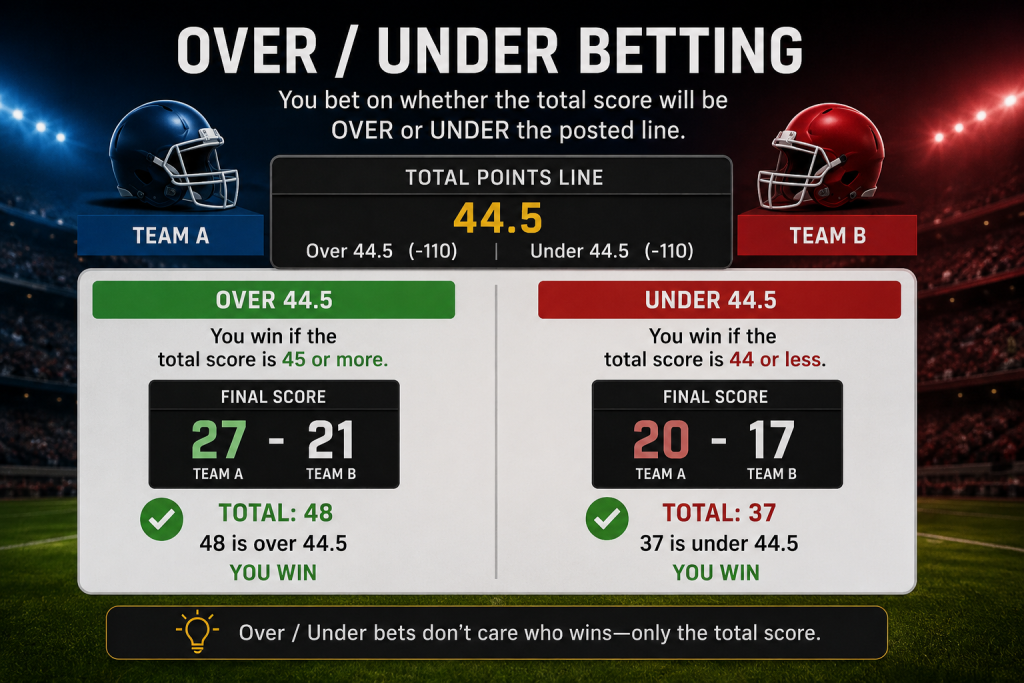
An over/under bet, also known as a total bet, is a wager on whether the combined total of a statistic in a game will be higher or lower than a number set by the bookmaker. Instead of predicting which team will win, you’re betting on an overall total. For example, if an NFL game has a total of 46.5 points:
- Over 46.5 wins if 47 or more points are scored
- Under 46.5 wins if 46 or fewer points are scored
Over/under betting is popular because it’s simple to understand and applies to almost every sport. You can bet on total points in football, goals in soccer, runs in baseball, rounds in boxing, and even individual player statistics with our online betting site.
What is an Over/Under Bet?
An over/under bet is a wager on whether a result will finish above or below a target number set by the bookmaker. Whether you are watching rugby, soccer, or almost any other sport, you can bet on whether the event will contain over or under a certain number of scores.
Total bets cover far more than just the combined score. You can bet on over five interceptions in an NFL game, under three tries by a rugby team, or even over 50 laps led by one driver in NASCAR or Formula One.
Over/under betting remains one of the most popular markets because it is simple and often offers strong value. It is also closely linked with handicap betting, as both markets are influenced by factors like team strength, pace of play, and expected game script. If bookmakers expect a dominant favourite and a fast-paced game, the total will usually rise. If they expect a slower, possession-heavy match, the total may fall.
Over-Under Odds
Most sportsbooks automatically calculate your potential returns once you enter a stake. However, understanding how over-under odds work yourself makes betting much easier. Using fractional odds as an example, imagine Germany vs Scotland has a total set at 2.5 goals. If over 2.5 goals is priced at 8/11, the bookmaker believes three or more goals are likely. Because the first number is smaller than the second, the profit is lower than your stake. A €100 bet at 8/11 would return €172 in total, including €72 profit.
Meanwhile, under 2.5 goals might be priced at 11/10. Since the first number is larger, the profit exceeds your stake. A €100 bet would return €210 in total, including €110 profit. In simple terms, shorter odds suggest a more likely outcome, while bigger odds indicate a less likely result with a larger potential payout.
What is a Push?
If you are new to online betting, over/under markets can look confusing because some totals use whole numbers while others use decimals. For example, you might see over 3 goals in soccer, over 222.5 points in basketball, or under 9.5 runs in baseball.
The decimal system exists to avoid ties. If you bet on over 50 points in an NFL game and exactly 50 points are scored, your wager becomes a push. In this situation, the online betting site refunds your stake. Using totals like 50.5 removes that possibility because the result must finish clearly over or under the line. Sportsbooks may also refund over/under bets if an event is postponed or abandoned, but this varies.
How to Bet Over/Under?
Signing up for a betting site and placing an over/under bet is easy. However, each sport you decide to wager on might have subtle differences for this type of wager. To avoid mistakes when placing your bet, here is a breakdown of some popular sports and the available markets.
NFL Over-Under Betting Example
Over/under betting is one of the most popular wager types in the National Football League (NFL). Instead of predicting which team will win, you are betting on the total number of points scored in the game by both teams combined. Let’s say the total is 47.5 points for a particular matchup.
- Over 47.5 points wins if 48 or more total points are scored.
- Under 47.5 points wins if 47 or fewer total points are scored.
Over-Under Soccer Example
Soccer is one of the most popular sports for over/under betting because matches typically feature a predictable scoring range. The most common total market focuses on the number of goals scored in a game. The line is often 2.5 goals for many competitive matches. This number represents the combined total of both teams.
- Over 2.5 goals wins if three or more goals are scored in the match.
- Under 2.5 goals wins if the game finishes with two or fewer goals.
The reason sportsbooks use a half-goal (2.5 instead of 2) is to eliminate the possibility of a tie, known as a push. The result must clearly land on one side of the line. For example, if the final score is 2–1, the total is three goals, and the over bet wins. If the match ends 1–0 or 1–1, the under bet wins. Other soccer bets include over/under for the total corners taken. You can also bet on areas like over ten shots on target, under four yellow cards, and over five offsides.
Rugby Betting Over-Under
Betting on Rugby is well-suited to over/under betting because matches often produce consistent scoring patterns. The most common total market focuses on the combined number of points scored across 80 minutes. If the market is set at 49.5 points for a particular match, then the expectation is a high-scoring game.
- Over 49.5 points wins if 50 or more points are scored.
- Under 49.5 points wins if 49 or fewer points are scored.
Because the line includes a half-point, there is no possibility of a push. The result must clearly fall on one side of the total. Once you sign up at Novibet, you can claim your welcome bonus and experiment with different wagers. Choosing the over-under bet for a rugby game is usually a good idea. That’s because you can end up with a winning bet no matter who wins, even if the match ends in a draw.
Golf Over/Under Betting Example
Over/under betting in golf works slightly differently because the sport is based on individual scores rather than team totals. Instead of points, you are usually betting on round scores, tournament totals, or specific statistics such as birdies. For example, a first-round total of 69.5 strokes for a golfer. Because conditions vary from course to course, including weather, course length, and difficulty, totals in golf can fluctuate significantly from event to event.
- Over 69.5 wins if the player shoots 70 or higher.
- Under 69.5 wins if the player shoots 69 or lower.
UFC/Boxing Over-Under Betting Examples
Combat sports are an excellent way to experience over-under bets. This type of wager usually focuses on the rounds you expect the fight to last. In boxing, the important championship fights are 12 rounds, and UFC title fights comprise five rounds. The fundamental difference is that a boxing round lasts three minutes and a UFC round lasts five. Your standard boxing fight or undercard is usually ten rounds or fewer, and UFC is typically three.
If you are a fan of combat sports or have experience betting on the UFC, you will see the over-under fluctuate massively between fights. That is because this number depends on the fighters in the ring. If there are two heavyweights with a reputation for knockouts, then the sports betting site will lower the total. They will set the total higher in bouts where a knockout is unlikely. If one of your UFC predictions is that a fight will go the distance, then you should bet over the number of rounds stated. Go for the under if you expect a knockout or an early stop in the bout. Let’s examine 3.5 rounds for a UFC bout.
- Over 3.5 rounds wins if the fight reaches the fourth round.
- Under 3.5 rounds wins if the fight ends before that point.
GAA Over-Under Betting
Over-under betting for GAA events is a lot of fun. Like the other sports listed above, you can bet on the total goals scored in a game. The same markets apply whether you want to bet on Gaelic football or hurling matches. You can also bet on the over/under for total points scored in regular time.
What is Total Betting?
In case you are unsure, total betting is the same as the over/under. The wager has two names, but there is no difference between them. If you think there will be over 200 points scored in an NBA game or under 50 in rugby, you can use this wager. The over-under gives you the chance to bet on a sporting event without predicting the winner.