





The Ultimate Fighting Championship is the biggest mixed martial arts promotion in the world. Founded in 1993, it has come a long way since the early sideshow feel. The original format had sumo wrestlers scrapping with kickboxers half their size in a no-rules tournament. Compare that to the modern era of elite, highly trained athletes competing under a unified set of rules like other combat sports.
Much of the success is owed to CEO and president Dana White, who transformed the promotion from a laughing stock into a legitimate mecca of MMA. However, with events taking place almost weekly throughout 2025, you would expect the sport to be one of the most-watched on Earth. Yet, many fans feel that the UFC is on the decline and White’s role in holding it back has been significant.
UFC Initial Struggle and Eventual Rise
While White’s involvement in the UFC from 2001 was integral to its success, it was not always plain sailing. In fact, there were probably more lows than highs in the early years. The company was close to collapse several times. However, White’s biggest strength is what saved them: he knew how to build stars, and he knew how to put together must-see TV events. A thriving light heavyweight scene chock-full of soap opera-level drama between some of the best UFC fighters of all time, like Tito Ortiz, Chuck Liddell and Ken Shamrock, kept people coming back in the early noughties.
The creation of The Ultimate Fighter, an MMA reality show, and the resulting rivalry between Forrest Griffin and the late Stephan Bonnar in the mid-2000s culminated in a fight so legendary that White himself refers to it as ‘the fight that saved the UFC’. The pure talent and domination from legends such as Georges St. Pierre, Jon Jones, Anderson Silva, and Jose Aldo captivated audiences throughout the latter stages of the noughties and into the early 10s.
However, by 2015, Jones had his first of a string of failed drug tests. Silva did one better by losing his title, failing a drug test, and beginning a losing streak. St. Pierre was in the second of a four-year hiatus after vacating his title, leaving Jose Aldo as the last man standing.
The McGregor Effect in MMA
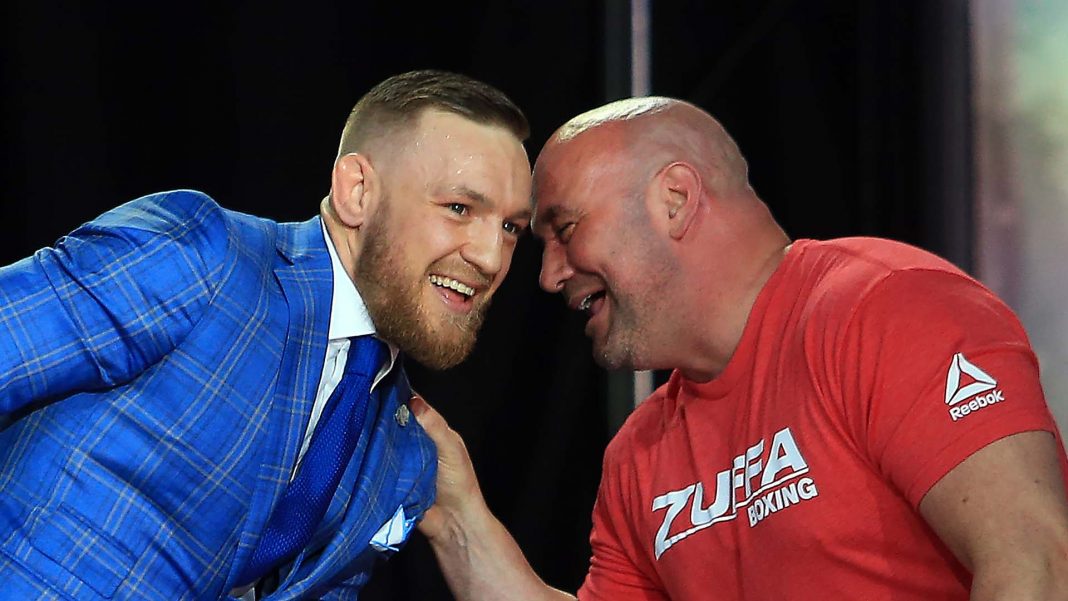
Whatever you think of the man, Conor McGregor’s role in the rise of the UFC is undeniable. His meteoric rise to the top came at a time when the company desperately needed a new superstar. McGregor filled that void better than anyone in the promotion’s history. A magnetic personality, charisma oozing from his pores, a stick of dynamite in his left fist and an unmatched ability to sell a fight turned him into must-see television almost overnight. But McGregor’s ascent wasn’t simply organic. Dana White recognised immediately what he had on his hands: a once-in-a-generation showman who could transcend the sport.
McGregor was the biggest crossover superstar the sport had ever seen, and White capitalised on that momentum at every turn. He became the first-ever double-champ in UFC history. His fights printed money, with nearly half of the top 20 biggest-selling combat sport PPVs being headlined by him.
The Mayweather boxing match pushed McGregor into an entirely different stratosphere commercially, and though it wasn’t a UFC fight, White’s involvement ensured the promotion reaped the benefits. Boxing was dead, and MMA, namely the UFC, was the new kid on the block. They were outselling their older brother, putting on weekly events and finally shedding their ‘bloodsport’ moniker for neutral fans who now had a genuine interest in MMA.
The arrival of women’s MMA in the UFC, namely Ronda Rousey, looked to have put the nail in the coffin for boxing. She came to the promotion in 2013 in the first-ever women’s bout in UFC history and burst through the proverbial glass ceiling to showcase women’s MMA. Rousey became an instant star, and her legendary championship run helped take the sport to new heights. She and McGregor became the faces of the promotion and bona fide superstars.
Yet this is where the argument about the UFC’s decline begins. McGregor and Rousey’s success, along with White’s reliance on megastar-driven matchmaking, shifted the UFC toward spectacle over sport. Instead of building deep divisions with consistent merit-based title shots, the company increasingly centred itself around personalities, money fights, and short-term buzz. The strategy worked brilliantly in the McGregor era, but the long-term consequences are becoming more apparent in 2025.
Oversaturation
The UFC started putting on weekly events to capitalise on the surge in mainstream attention around 2012. For a long time, it worked. More cards meant more fighters getting exposure, more opportunities for highlight moments, and more content for ESPN and international broadcasters. Between 2012 and 2021, the likes of Jon Jones, Conor McGregor, Ronda Rousey, and Khabib Nurmagomedov put butts in the seats.
But there is a tipping point, and the UFC passed it long ago. What was once a can’t-miss spectacle has become routine background noise. Cards that used to feel stacked with ranked contenders now often feature one meaningful fight at the top. Underneath, a patchwork of developmental matchups.
The problem is not volume alone, but quality. The talent pool has not grown at the same rate as the schedule, resulting in a sharp decline in depth. Fight nights are regularly headlined by bouts that would have previously been buried on a prelim. Fans feel it, fighters know it, and even the commentary teams sometimes subtly acknowledge it. Oversaturation has diluted the product to the point where many fans only tune in for title fights or big-name attractions, weakening the weekly engagement that once kept the sport thriving.
UFC Pay and Promotion Issues
Fighter pay is another major point of contention and one that has alienated many athletes and fans alike. Despite record revenues, the UFC still pays a far smaller percentage of profits to its fighters than other major sports leagues. This has led to top talents walking away, boxing crossovers becoming more enticing, and athletes voicing discontent publicly.
When fighters feel undervalued, they fight less often and take fewer risks. Combined with the oversaturated schedule, this has created cards filled with underpaid fighters competing too frequently or refusing to sign important bouts altogether.
White’s dismissive attitude toward pay disputes has not helped. His public feuds with fighters, once entertaining, now contribute to the perception that the UFC prioritises corporate interests over athletic merit. Fans want to see the best fight the best, but contract standoffs and pay disagreements increasingly get in the way.
A Lack of New MMA Superstars
The UFC still has elite fighters, but it has struggled to create new mainstream superstars. Part of that is organic. It is difficult to replicate a figure like McGregor, who combined talent, timing, and charisma in a way no one else has. But part of it also stems from UFC’s promotional strategy. Rather than letting fighters build mystique or momentum, the UFC pushes them into hyperactivity. Undefeated prospects are rushed into title fights, champions are booked in quick turnarounds, and rivalries feel manufactured rather than earned. The company’s marketing machine no longer elevates talent the way it once did.
As a result, the UFC has few fighters who crossover to mainstream sporting relevance. There are tonnes of exceptional athletes in the UFC, but they lack the broader visibility that past champions enjoyed. The visibility they do have tends to rely on moments going viral rather than intentional, sustained promotion.
Poor Matchmaking and Protected Fighters
One of the most glaring signs of the UFC’s decline is the rise of poor matchmaking, and nothing captures this better than Dana White’s refusal to set up a title fight between Tom Aspinall and Jon Jones. It was the matchup that fans wanted, the matchup that made sporting sense, and the matchup that would have defined an era.
Instead, White insisted on preserving Jones for a legacy fight against Stipe Miocic, a bout that had far less competitive relevance and that precisely no one wanted to see. Aspinall, the interim champion, was left in limbo despite being the clear next man in line. This decision highlighted a broader issue within the UFC. Dana White has too much control and insists on playing favourites, prioritising narrative (even when it doesn’t exist), and brand protection over fair competition.
Exhibit 9377448 that Jon wants nothing to do with Aspinall?
If he wants to retire why is he interested in Francis? Or Stipe before him.
It’s either you want to fight or not (like GSP decided twice).
Mockery. pic.twitter.com/0GrNBzKuCN
— Ariel Helwani (@arielhelwani) June 8, 2025
This problem is not new in combat sports. Boxing has been plagued by marquee fights being delayed for years or never happening at all. Fans waited nearly a decade for Floyd Mayweather vs Manny Pacquiao, and when it finally arrived, both fighters were past their peaks.
Meanwhile, Tyson Fury vs Anthony Joshua remained trapped in a maze of rival promoters, broadcast deals and contractual politics to a point where the moment has now passed. Boxing’s fractured structure and the presence of multiple promoters make these delays almost inevitable. That is a huge reason that the UFC began to surpass the sport in the 2010s.
But the UFC does not have that problem. It operates as a single entity with complete control over matchmaking, belts, and fighter schedules. There are no rival promoters blocking negotiations, no sanctioning bodies mandating different matchups, and no broadcast conflicts forcing delays.
The UFC could make any fight it wants at any time. If a fighter rejects the bout, the old Dana White would tell them to go f*ck themselves. There is no way the UFC president of 2010 would allow Jon Jones to duck Tom Aspinall as he did. Now, when those fights still fail to materialise, the blame lands squarely on White and the organisation’s internal priorities.
https://twitter.com/ChampRDS/status/1932197785501089984?s=20
In the post-McGregor era, where stars are few and far between, White appears increasingly protective of fighters he sees as commercial assets like Jones. Rather than risking an established star suffering a damaging loss, he often opts for favourable matchups or legacy bouts that are safer from a promotional standpoint.
That itself is White’s fault. The moment a slight whiff of a new star hits his nose, he rushes them to prospective superstardom only to watch them fall, land flat on their face and eventually get left behind. For that reason, he has to hold on to the stardom of 40-year-olds and hold up an entire division in the process, to the detriment of the product.
The result is a product that feels manipulated, with sporting legitimacy taking a back seat to curated narratives and risk management. Fans sense when the best are not fighting the best, and the UFC is beginning to slip into the same pattern that once crippled boxing. The difference is that the UFC has no structural excuse. These are self-inflicted decisions, and they are steadily chipping away at the sport’s competitive integrity.
Is There A Way Back for the UFC?
Yes, there is absolutely a way back for White and the UFC. But it is not going to happen overnight. The good news is that the promotion still has the infrastructure, brand recognition, and global reach to reclaim the momentum it has lost. The UFC remains the undisputed leader of MMA, and the sport itself is healthier and more technically advanced than ever. The issue is not the athletes or the competition; it is the decision-making at the top.
To reverse the decline, the UFC must return to what made it great in the first place. They need consistent meritocratic matchmaking, slow-burning storytelling, and the willingness to let new stars emerge naturally rather than forcing them into premature spotlight moments.
To White’s credit, Paddy Pimblett’s stock has only got higher with each performance. While his ilk have been a rarity in recent years, it is at least a sign that White is learning from his mistakes. Nurturing talent instead of rushing it gives fighters time to develop real skills, momentum, and fan investment. If the UFC can apply that philosophy across divisions, rebuild competitive structures and stop treating fighters like short-term content assets, a revival is not only possible but inevitable.
"WHAT NOW?" 🗣️
PADDY PIMBLETT WITH A STATEMENT VICTORY OVER MICHAEL CHANDLER 😳 #UFC314 pic.twitter.com/vJZpzRPrzm
— ESPN (@espn) April 13, 2025
Fixing fighter pay would go a long way. A better revenue split and improved contract structures would not only retain talent but also encourage fighters to stay active and take risks. A deeper, more motivated roster leads to better cards, which in turn draws more viewers. It would also stop their stars from having their heads turned by boxing, which is far more lucrative.
Cutting back on oversaturation would also help. Not every weekend needs a card. Fewer events with higher quality would restore the sense of importance the UFC used to command. Plus, the timing of UFC events always seems to favour an American audience. Having events that finish at a reasonable time will help European audiences avoid crazy late nights.
The UFC’s decline is not terminal. It is a course correction waiting to happen. The promotion has recovered from its worst moments, and MMA fans are some of the most loyal in the world. Fans have not turned away because they no longer love Mixed Martial Arts. They have turned away because the product has drifted from what made it special. If White and the UFC can return to prioritising sporting legitimacy over short-term profit, they can spark a new golden era. The UFC became massive because it embraced what boxing could not. If it wants to remain global, it needs to remember why fans fell in love with it in the first place.