

Formula 1 is one of those sports with technical jargon, mysterious acronyms, and plenty of drama on or off the track. One term that gets mentioned in almost every race is DRS. It is sometimes celebrated as the ultimate overtaking weapon, other times criticised as an artificial gimmick.
Love it or hate it, the system has been a game-changer since its debut. It has influenced race strategy, shaped on-track battles, and even sparked heated debates among fans and drivers alike. In this guide, we’ll break down exactly what DRS is, how it works, and when it can be used. We will also examine why it’s controversial, and what’s coming next as F1 prepares to replace it in 2026.
What is DRS in Formula 1?
DRS stands for Drag Reduction System. It is one of those terms you’ll hear constantly if you watch Formula 1 these days. DRS was introduced to Formula 1 in 2011 as part of a package of changes aimed at improving overtaking and overall race spectacle. At the time, F1 faced heavy criticism for producing processional races. Cars struggled to pass due to the turbulent “dirty air” created by modern aerodynamics.
The Drag Reduction System was designed to counter this by giving chasing drivers a straight-line speed boost when within one second of the car ahead. Its debut season saw immediate impact. Drivers recorded more on-track passes than in previous years. However, it also sparked debate about whether the technology made overtaking too artificial.
It’s also one of those things that can sound more complicated than it actually is. In reality, the basic idea is simple: if you’re close enough to the car in front, you get to open a flap on your rear wing, reduce aerodynamic drag, and go faster. But as with most things in F1, the simple idea has a lot of rules, strategies, and occasional controversy behind it.
How Does DRS Work?
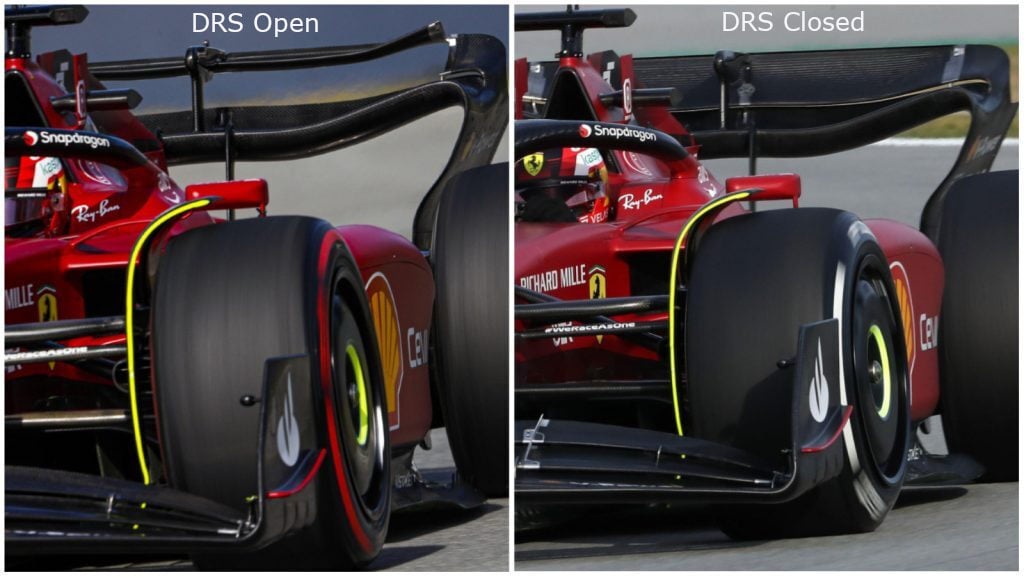
The Drag Reduction System is built into the rear wing of the car. Under normal racing conditions, the rear wing is fully closed, generating maximum downforce. This invisible force “pushes” an F1 car towards the ground, keeping it stuck to the track through corners. The downside of downforce is drag. The more grip you have in corners, the more air resistance you fight on the straights.
This is where DRS comes in. When activated, a section of the rear wing (usually the upper flap) swings open, creating a gap. This alters the airflow, significantly reducing drag. Suddenly, your car is slicing through the air instead of ploughing through it, giving you a speed boost that can be anywhere from 10 to 20 km/h (sometimes even more, depending on the track and conditions).
When Can DRS Be Used?
Unfortunately for F1 drivers, you can’t activate DRS every time you see a straight. There are strict rules as to when and where you can use DRS during a race.
- One-Second Rule: In a race, you can only activate DRS if you’re within one second of the car in front at a designated detection point. This is measured electronically by F1’s timing system.
- DRS Zones: Each track has set “activation zones” where DRS can be used. These are almost always on the straights, never in corners.
- Not at Race Start: DRS is disabled for the first laps of a race or after a safety car restart. It’s only enabled once normal racing conditions are underway.
- Dry Conditions: The Drag Reduction System is only available in dry racing conditions. If the track is wet, race control will disable DRS until a dry line appears on the track.
- Qualifying & Practice: In qualifying and practice sessions, drivers can use DRS at any time within the activation zones, as no car in front is required. This is to help them set the fastest possible lap times.
Where Does DRS Matter The Most?
Some tracks are tailor-made for DRS battles. Monza, affectionately nicknamed the “Temple of Speed”, has long straights where the slipstream plus DRS can make overtaking almost guaranteed if you’re close enough. Bahrain is another good example, with two long straights and heavy braking zones that make DRS passes both possible and spectacular.
In contrast, on twistier circuits like Monaco, DRS is almost useless. Even with the flap open, the track layout just doesn’t offer enough straight-line space to complete a clean pass without taking huge risks.
Controversies Around DRS
Since its introduction in 2011, some fans and purists have criticised DRS for making overtaking too easy. Before DRS, a pass often meant a huge risk under braking, late moves, and real wheel-to-wheel drama. With DRS, critics argue, you can sometimes just breeze past without much of a fight. This is especially prevalent on circuits with long, powerful DRS zones.
A good example of this “too easy” complaint was the 2013 Hungarian Grand Prix. The DRS zone on the main straight was so powerful that cars would fly past before even reaching the braking point, removing much of the suspense. Fernando Alonso, one of the best F1 drivers of all time, was fined after the race for misusing DRS.
On the flip side, supporters point out that without DRS, many races would turn into processions. One car would stick behind another with no chance to pass because modern F1 aerodynamics make following closely so hard. DRS gives us the kind of close battles and lead changes that keep races exciting for the casual viewer.
What is The Future of DRS?
From 2026, Formula 1 will scrap DRS as part of sweeping regulation changes. In its place, every car will have access to a low-drag mode on straights, usable at any time regardless of proximity to another driver. Two new power-boost modes will take over DRS’s role on the steering wheel: Z-mode and X-mode.
Z-mode opens elements on both the front and rear wings, increasing downforce for faster cornering. X-mode reduces drag to maximise straight-line speed. These modes will only be available in designated zones around each track and can be activated manually, giving drivers greater tactical flexibility.